
The Role of Creativity in Driving EV Adoption by 2030 and Beyond
Countdown to the EV Cultural Impact Awards
Days --
Hours --
Minutes --
Seconds
How art, storytelling, advertising, and music are transforming public perception and accelerating the electric vehicle revolution
The transition to electric vehicles is often framed as a technical and economic challenge: battery costs, charging infrastructure, range capabilities, and grid capacity dominate policy discussions. Yet beneath these practical considerations lies a more fundamental question: How do we inspire people to embrace a fundamentally different relationship with personal transportation? The answer increasingly comes not from engineering departments, but from artists, storytellers, musicians, and creative agencies who are reshaping how we think about electric mobility.
The Power of Narrative
Humans are storytelling creatures. We don’t make decisions based solely on specifications and cost-benefit analyses—we respond to narratives that resonate with our values, aspirations, and identities. The creative community has recognized that electric vehicles need more than rational arguments; they need compelling stories that make them desirable, not just defensible.
Consider how Tesla transformed EV perception not through traditional advertising (the company famously spends almost nothing on conventional ads), but through storytelling. The narrative wasn’t about saving the planet—it was about performance, innovation, and being part of a technological vanguard. The company’s product launches became cultural events, generating organic media coverage worth hundreds of millions in equivalent advertising value. Elon Musk himself became a character in the story, for better or worse, making electric vehicles feel dynamic and newsworthy rather than worthy but dull.
Other manufacturers have learned from this approach. Porsche’s Taycan campaign emphasized that electric doesn’t mean compromising performance—it means redefining it. Rivian positioned its vehicles as adventure-ready, appealing to outdoor enthusiasts who might have dismissed EVs as urban appliances. These narratives matter because they address unspoken concerns: Will I have to give up what I love about driving? Will this vehicle reflect who I am?
Visual Arts and Public Imagination
Artists have long engaged with themes of technology and environment, but the electric vehicle movement has inspired a new wave of creative work that makes sustainable mobility tangible and aspirational. Street artists in major cities have created murals depicting clean, quiet urban futures. Installation artists have transformed charging stations into sculptural landmarks rather than mere utility infrastructure.
The Museum of Modern Art’s 2021 exhibition featuring automotive design included electric vehicles not as environmental curiosities but as legitimate design achievements. This institutional validation matters—it signals that EVs have transcended their functional purpose to become objects worthy of aesthetic consideration. When vehicles like the Lucid Air or the BMW i Vision Dee concept appear in design magazines alongside furniture and architecture, it normalizes electric vehicles as part of contemporary culture rather than a subcultural phenomenon.
Photography and film have played crucial roles too. The visual language of EV marketing has evolved from sterile showroom shots to dynamic imagery that emphasizes motion, light, and integration with landscape. Cinematographers have discovered that electric vehicles’ silent operation creates new possibilities for sound design in film, where the absence of engine noise allows more nuanced audio storytelling.
Music as Cultural Accelerant
Music’s relationship with cars is legendary—from Chuck Berry’s “Maybellene” to Tracy Chapman’s “Fast Car,” automobiles have provided endless inspiration. The challenge for electric vehicles was whether they could generate the same emotional resonance without the visceral rumble of internal combustion engines.
Musicians are answering affirmatively. Electronic artists have embraced EVs as logical extensions of their aesthetic, creating soundscapes that match vehicles’ futuristic design. Hip-hop artists, long associated with automotive culture, have begun featuring electric vehicles in music videos, signaling that EVs can be aspirational and cool rather than earnest and awkward.
More interestingly, composers are exploring what EVs themselves sound like. Since electric vehicles must emit artificial sounds at low speeds for pedestrian safety, there’s an opportunity for sonic branding. BMW worked with composer Hans Zimmer to create distinctive EV sounds. Audi collaborated with musicians to develop audio signatures that enhance the driving experience. These aren’t just functional alerts—they’re designed to be emotionally engaging, creating new sensory associations with electric mobility.
Concerts and music festivals have become unexpected venues for EV promotion. Major festivals now feature electric vehicle displays and charging infrastructure, associating EVs with youth culture and progressive values. Artists like Billie Eilish and Radiohead, known for environmental advocacy, have incorporated EV messaging into tours, reaching audiences who might not engage with traditional automotive marketing.
Advertising’s Evolution
The advertising industry faces a unique challenge with electric vehicles: how do you market products that might be better for the planet but initially cost more and require behavioral changes? The answer has been to focus less on environmental messaging and more on human benefits.
Volvo’s EV campaigns emphasize safety and Scandinavian design rather than sustainability. They recognize that while environmental concern influences purchases, it rarely tops the list of priorities. Similarly, Ford’s F-150 Lightning advertising focuses on power, capability, and innovation—values that resonate with truck buyers regardless of environmental stance.
The most effective campaigns tell human stories. General Motors’ “Everybody In” campaign featured diverse voices and highlighted accessibility, suggesting that EVs are for everyone, not just coastal elites. Audi’s Super Bowl commercial starring e-tron featured a grandmother discovering electric performance, challenging assumptions about who EVs are for.
Humor has proven surprisingly effective. Volkswagen’s “VDub” campaign for ID.4 used comedy to address range anxiety and charging concerns directly, defusing anxiety through laughter. Hyundai’s ads featuring actor Jason Bateman acknowledged that EVs are still relatively new and occasionally confusing, building trust through honesty rather than hype.
Social media has amplified creative approaches, allowing campaigns to reach targeted audiences more efficiently than traditional broadcast advertising. Influencers who aren’t explicitly automotive-focused—lifestyle, tech, and family content creators—have become crucial voices, normalizing EVs by integrating them into everyday life content rather than treating them as special objects.
The Gaming and Virtual World Connection
Perhaps unexpectedly, video games have become important venues for familiarizing people with electric vehicles. Racing games now feature EVs prominently, and players are discovering that electric vehicles can be thrilling rather than compromised. The silent acceleration and instant torque translate surprisingly well to gaming experiences.
Virtual worlds and metaverse platforms are incorporating electric vehicles into their ecosystems, allowing users to experience EVs in digital spaces before encountering them physically. This matters particularly for younger audiences who will be entering the vehicle market in coming years—they’re developing positive associations before ever sitting in a driver’s seat.
Design as Communication
Product design itself is a form of creative expression that shapes adoption. The earliest mass-market EVs looked aggressively different—the original Nissan Leaf and BMW i3 announced their electric nature through unconventional styling. This made them visible but also marked them as “other,” something separate from normal cars.
Contemporary EV design has evolved toward a more sophisticated approach. Some vehicles, like the Porsche Taycan, are subtly different from conventional cars—electric by choice rather than necessity. Others, like the Tesla Model S or Lucid Air, establish new design languages that don’t reference internal combustion predecessors. Still others, like the Ford F-150 Lightning, deliberately maintain familiar forms to reduce psychological barriers to adoption.
This diversity in design philosophy reflects deeper questions about whether electric vehicles should be revolutionary or evolutionary. The creative answer seems to be “both”—provide options for people who want to signal change and for those who want familiarity with improved technology.
Interior design has been liberated by electric architecture. Without transmission tunnels and engine intrusion, designers can create more flexible, spacious cabins. Some designers are reimagining interiors as mobile living rooms or offices, expanding the creative conversation beyond transportation to encompass how we use vehicle time itself.
Education Through Entertainment
Documentary filmmakers have found compelling stories in the EV transition. Films like “Revenge of the Electric Car” and “Who Killed the Electric Car?” framed the technology in terms of corporate drama and technological resurrection narratives. More recent documentaries explore supply chains, grid transformation, and community impacts, making complex systems accessible through human stories.
Podcasts dedicated to electric vehicles and sustainable transportation have built engaged communities. These aren’t just information sources—they’re creative products that use narrative techniques, sound design, and interview formats to make technical topics engaging. Hosts become personalities that audiences trust, influencing purchasing decisions through sustained relationship rather than one-time marketing messages.
Children’s books featuring electric vehicles are shaping the next generation’s default assumptions. When kids grow up with books where electric cars are normal, they won’t experience the same conceptual shift that current adults face. This long-term cultural work might be the most consequential creative contribution of all.
Challenges and Criticisms
The creative community’s engagement with electric vehicles isn’t without criticism. Some argue that focusing on making EVs desirable perpetuates car-dependent culture when we should be promoting public transit, walking, and cycling. Others note that creative campaigns often reach already-sympathetic audiences rather than converting skeptics.
There’s also concern about “greenwashing”—using creative excellence to obscure environmental or social problems in supply chains. Artists and creative professionals must balance enthusiasm for electric technology with honest acknowledgment of remaining challenges, from mining impacts to electricity grid carbon intensity.
The industry must be careful not to replicate the problematic aspects of automotive culture in an electric context. Celebrating excessive consumption, even of electric vehicles, misses the larger point of sustainability. The most thoughtful creative work acknowledges that EVs are part of a broader transformation toward more sustainable, equitable mobility systems.
The Road to 2030
As we look toward 2030, when many countries aim for substantial EV adoption, creativity will remain essential. Technical improvements will continue—batteries will get better, charging will get faster, costs will decrease. But these advances won’t matter if people don’t want electric vehicles or if EVs remain associated with sacrifice rather than improvement.
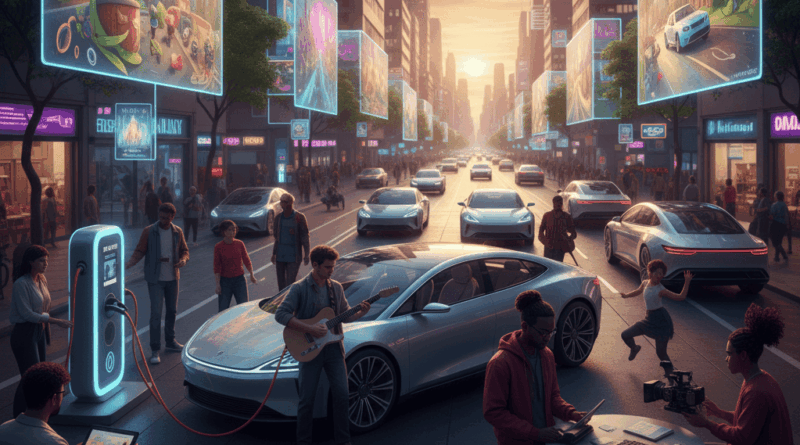
The creative community is helping reframe that conversation. Through art that imagines cleaner cities, music that gives EVs cultural cachet, advertising that addresses concerns with honesty and humor, and design that makes electric vehicles genuinely desirable, creatives are doing the cultural work that enables technical transformation.
The most powerful creative contribution might be the simplest: normalizing electric vehicles by integrating them into the cultural landscape. When EVs appear in movies not as plot devices but as everyday transportation, when they’re featured in music videos without explanation, when they’re simply present in the visual background of contemporary life—that’s when adoption accelerates from early adopters to mass market.
The electric vehicle revolution will be engineered, certainly, but it will be imagined, narrated, designed, scored, and visualized first. The distance from today to a predominantly electric vehicle future is measured not just in battery capacity and charging stations, but in stories told, images created, songs written, and possibilities imagined. That creative work is already happening, reshaping not just what we drive, but how we think about mobility, technology, and our relationship with the planet.
By 2030, the creative community’s contribution to EV adoption may be as significant as any technical breakthrough—proving that the most sustainable innovations are those that capture not just our rational minds, but our imaginations and emotions too.